Anatomical Pathology
This is a five year program designed to provide the
training experiences required by the Royal College of
Physicians and Surgeons of Canada for specialty certification,
and to enable trainees to acquire the following knowledge,
skills and attributes.
Consultative Functions
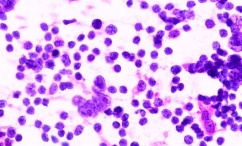
a) Data Acquisition and Interpretation - recognition and diagnostic interpretation
of cellular and tissue abnormalities;
b) Test Selection - appropriate application of special
techniques to tissue specimens for diagnostic and investigative
purposes.
Professional Knowledge
a) The basic responses of cells and tissues to adverse stimuli;
b) The principles and applications of various types of microscopy; including
electron microscopy; routine and special staining procedures; of photography
in recording gross and microscopic lesions;
c) System diseases and their range of pathologic and clinical expressions,
including relationships to other laboratory test results, and;
d) Coding and retrieval systems for diagnostic information.
Managerial Functions
Principles of management and administration of the laboratory, and the relationships
with hospital administration.
Education and Research
a) Participation in regular educational activities, such as rounds, and in
academic centres, teaching programs;
b) Appreciation and exploitation of the research potential of the service experience.
Program Content
PGY1 - This year is equivalent to a rotating internship during
which the resident obtains experience in a variety of clinical disciplines.
PGY2 - This is spent a the QE II Health
Sciences Centre, VG site. During the first week, instructions
are offered in the basic techniques of autopsy and surgical
pathology, supplemented by a teaching collection of films
and slide-tape programs, including programs on principles
of tissue fixation, staining and histochemistry. During
the remainder of the year, the residents rotate in the
autopsy and surgical services, including quick-section
diagnoses, under staff supervision.
PGY3 - This consists of four rotations,
every three months, in cytopathology at the VG site;
neuropathology at the VG site; pediatric pathology at
the IWK Health Centre and in a mixed surgical and autopsy
pathology rotation. The latter rotation may take place
at the VG site or in Saint John Regional Hospital. Otherwise,
the Saint John rotation will be taken in the fourth year.
PGY4 - Apart from the three month
rotation to the Saint John Regional Hospital, this year
may be taken as the elective year depending upon previous
experience, progress and special needs. The Training
Committee will determine whether this opportunity is
provided to the resident. Programs may be organized to
allow residents (a) to correct deficiencies in knowledge
and training requirements; (b) receives in-depth experience
in one or more sub-specialty areas; and conduct patient-related
research under supervision of staff offerings special
programs. During this year, arrangements will be made
for a four week rotation in immunopathology and electron
microscopy.
PGY5 - This year provides the resident
with more intensive experience in autopsy and surgical
pathology at increasing levels of responsibility, usually
at the QE II Health Sciences Centre (VG site). The three
month rotation in forensic pathology also takes place
during this year (or occasionally during the PGY4 year).
Educational
During the first two years, residents are required to take Pathobiology courses
(PATH5040 and 5050) offered by the Department. Attendance at the academic
half day and other conference programs in autopsy and surgical pathology
are also required. There is also an extensive sub-specialty conference program
that residents are required or encouraged to attend depending on the rotation. |